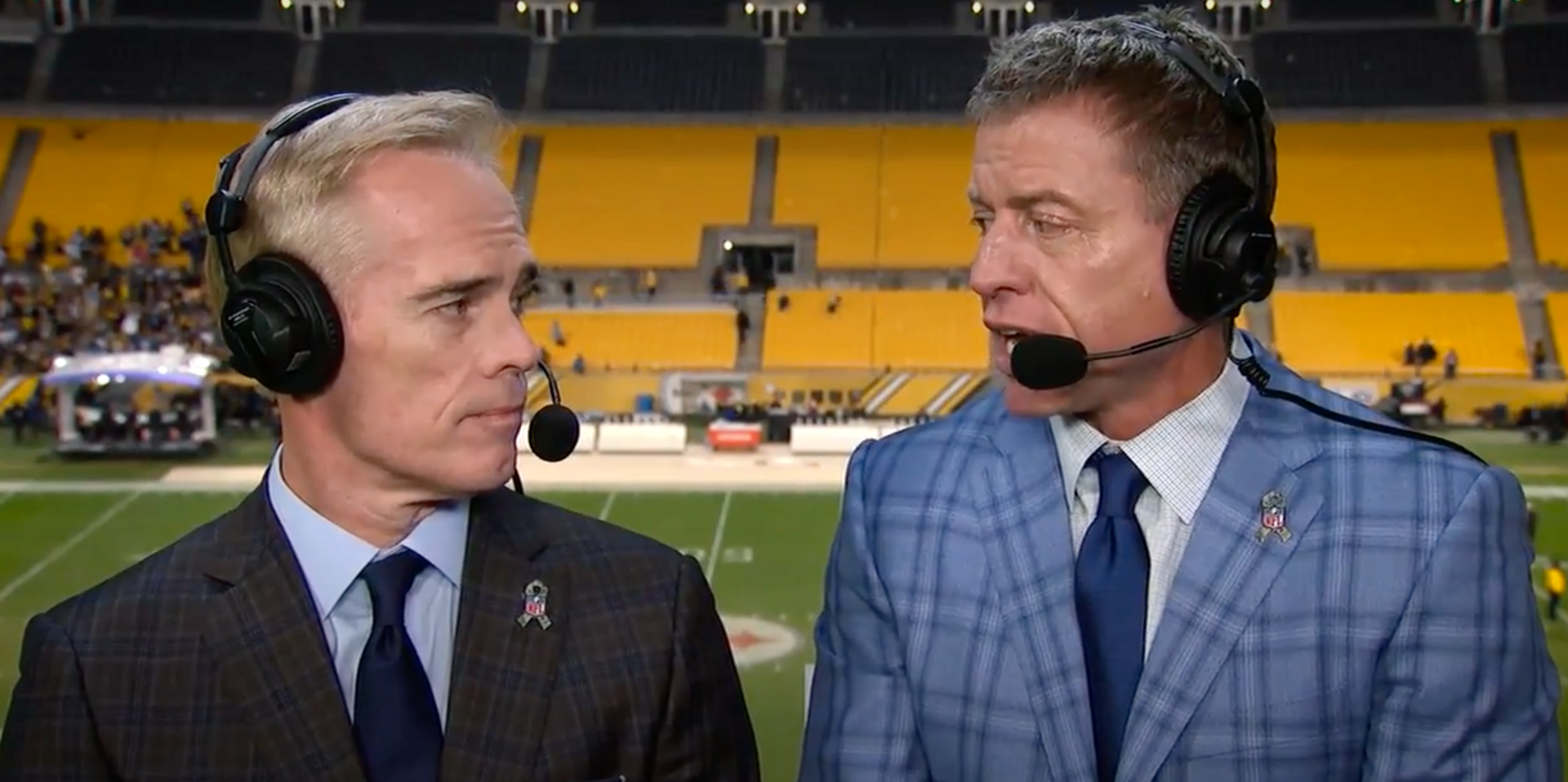

November 19: the full radio exchange
George Dunham was hosting The Musers without his usual co-hosts when he invited Troy Aikman to join him in the studio. Aikman’s answer turned Dunham’s solo shift into a joke about Joe Buck wanting a one-man booth, then asked whether Dunham wanted the same arrangement on radio.
In the station’s full November 19 segment, the exchange leads into a brief mention of Buck’s Country Music Awards appearance. Dunham then moves the conversation to the Cowboys and 49ers. The Buck discussion sits at the opening of a much longer football interview; it is not a statement announcing a new Monday Night Football lineup.
Ryan Glasspiegel’s Front Office Sports report describes Aikman’s tone as light and the answer as delivered with laughter. It also says an ESPN spokesperson declined to comment on the remark. Mike Florio frames the exchange as another contribution to the reported tension. Those descriptions are commentary and reporting about the relationship, not contract documents.
The business distinction is between public expression and an agreed employment change. A pointed remark can draw attention to unresolved negotiations. It does not establish what ESPN has offered, what Aikman would accept, whether either partner has approved a different assignment or when any such change would take effect.
Buck’s separately reported renewal remains relevant market context. Its reported price and duration do not automatically transfer to Aikman, create a matching guarantee or define the authority of any possible football job. Those are separate decisions, and the radio exchange supplies no new terms for them.
November 3: the reported renewal and earlier career choices
The reporting and financial definitions below are the November 3 account. Its references to the state of negotiations and possible roles describe that dated snapshot.
Joe Buck’s reported renewal and Troy Aikman’s open career choices now run on different clocks. The contract reporting gives that difference a price and a duration. It does not establish what Aikman will do next, what ESPN must pay him or why either broadcaster made a particular decision.
In the publicly readable portion of his October 21 Puck report, Dylan Byers described Buck accepting a six-year ESPN extension at $18 million annually. Sports Media Watch’s November 2 analysis continued to describe Aikman as working without a new deal. These are attributed reports about separate negotiations, rather than a joint contract or an announced Aikman departure.
Six years at the reported $18 million annual figure implies about $108 million in nominal value. That multiplication does not establish a fully guaranteed balance, a payment schedule, termination provisions or remaining unpaid compensation. We have not reviewed the contract. Buck’s reported figure is context for the market; it is not an offer to Aikman.
Ryan Glasspiegel’s original October 14 Front Office Sports report described a pregame argument before Bills–Rams, citing a source, and said it de-escalated. ESPN declined comment. Glasspiegel also noted that the two broadcasters share CAA representation but have different agents. That reporting establishes an attributed account of tension; it does not turn a private relationship or an unannounced employment decision into a verified fact about motive.
 FULLY GUARANTEED
with J. Lalwani
A Cowboys conversation still needs a job description
Troy Aikman is willing to talk to Jerry Jones. That gives the Cowboys a conversation they could pursue, while leaving the important employment questions open: about what job, with what authority, on what terms?
In an October 25 article based on his interview with Aikman, CowboysRoundtable’s Mike Fisher reported that the former Dallas quarterback would consider an opportunity if Jones believed he could help the team. Aikman said, “I would welcome any conversation with Jerry.” That is an invitation to a discussion, rather than an announced hire.
The same interview also complicates the idea that Aikman has already chosen a life outside television. He described being in his final contract year at ESPN and said of broadcasting, “I hope it’s not over.” He discussed other possibilities, including another network, work with an organization and his business interests. Those are possibilities he raised, rather than competing offers we can put on a negotiating table.
Authority matters as much as a title
Aikman’s status as a former Cowboys quarterback makes the idea compelling. It does not write a job description. A general manager, a football adviser and a consultant can occupy very different places in a decision process. Before judging a proposed reunion, the useful question would be which decisions the role actually touches.
Advice is one product. Authority is another. A person can evaluate players, challenge assumptions and recommend changes without having the final say over a roster, a coaching decision or a budget. That can still be useful work. Its value depends on whether the organization has a defined way to consider the advice and act on it.
For Dallas, a conversation could test whether there is a specific need that Aikman’s experience would address. For Aikman, it could establish the scope of the work, the people involved and the time it would require. Neither side needs to promise a reunion simply to find out whether those requirements fit.
The alternatives matter, too. Continuing in broadcasting would use an established professional skill; organizational work would create a different daily commitment. A consulting assignment could have another scope again. These are analytical distinctions between potential jobs. They do not establish that any employer has made Aikman a particular offer, or that a particular arrangement is available.
An opening is not a price
That distinction also keeps the financial analysis honest. A possible Cowboys role has no verified compensation attached in the interview. An existing television contract does not tell us what a team would pay, what authority it would grant or whether a transition would require additional agreement. There is no reason to manufacture a price to make the speculation look more advanced.
Nor does the timing establish a private motive. Reports about broadcast relationships and public discussion of future jobs can coexist without proving that one caused the other. Aikman’s stated willingness to listen is enough to report. Assigning a hidden negotiating strategy would go beyond the evidence.
There is a human decision underneath the familiar Dallas reunion story: what kind of work someone wants to do next, and how much of an established career he wants to retain. Aikman’s published remarks leave room for more than one answer. That uncertainty belongs in the story.
The Fully Guaranteed verdict: take the invitation seriously, then wait for the particulars. If a substantive role emerges, its reporting lines, decision rights, responsibilities and terms will tell us far more than the reunion imagery. For now, Aikman has opened a conversation. The interview has not supplied an employment agreement.
The two negotiations remain separate
Our broader verdict: read the two negotiations separately. A reported renewal gives Buck a longer stated horizon, while Aikman’s public remarks leave several kinds of work open. Neither the comparison nor a reported disagreement supplies a signed Aikman agreement. The questions that would settle his next step remain practical ones: the role, its authority, its demands and the terms an actual employer is willing to offer.
Financial & reporting sources
- 96.7 The Ticket — full November 19 station podcast
- Ryan Glasspiegel, FOS — November 19 report and response
- Mike Florio — interpretation
- Dylan Byers, Puck — October 21 publicly readable opening, reported six-year/$18 million Buck terms
- Ryan Glasspiegel, Front Office Sports — original October 14 reporting on the booth disagreement and separate agents
- Armand Broady, Sports Media Watch — November 2 analysis and attribution chain
- Mike Fisher, CowboysRoundtable — original October 25 Aikman interview account