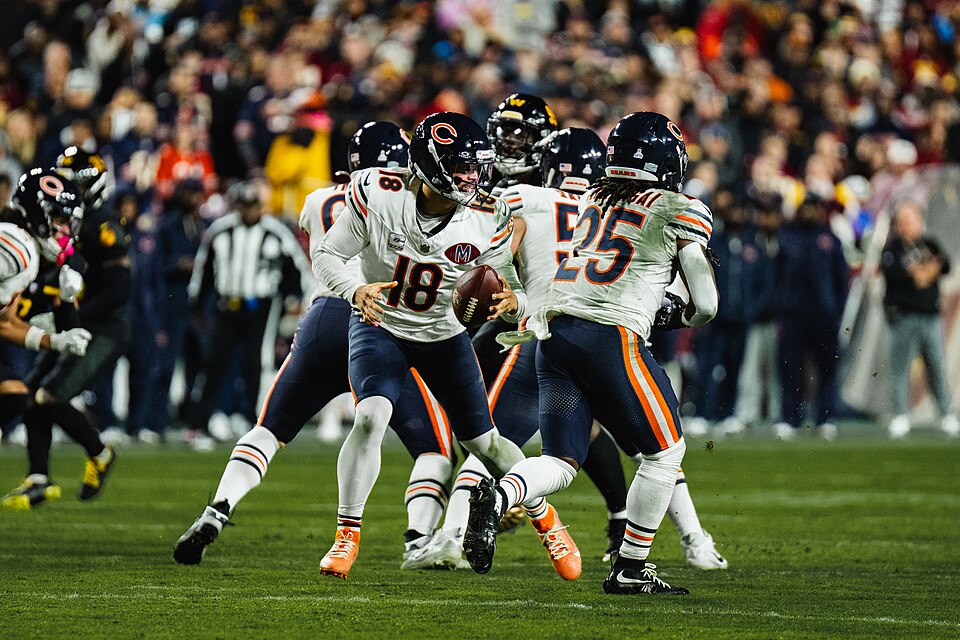

The first big contract decision for the 2024 quarterback class is approaching, but the calendar does not require six teams to deliver the same answer. After the last regular-season game of a drafted player’s third contracted year, the NFL permits a renegotiation. For this class, that opens a negotiating window after the 2026 season. It is permission to make a deal, not a deadline to make one.
Mark Maske’s November 18 report for Front Office Sports describes the debate around Caleb Williams, Jayden Daniels and Drake Maye, alongside Bo Nix, Michael Penix Jr. and J.J. McCarthy. An agent quoted anonymously favored paying Williams while raising durability concerns about Daniels and Maye and a performance question about Nix. Ryan Clark favored early extensions for Williams and Maye. Those are assessments of what teams should do, rather than reported offers or a consensus price.
The teams have another choice built into the contracts. First-round picks receive four-year rookie agreements with a team option for a fifth season. A club can seek an extension once negotiations are allowed, or keep evaluating the player under the existing agreement while addressing its option decision separately. The fourth contracted season for a player who signed in 2024 is 2027; a fifth-year option would concern 2028. An option mechanism does not mean the option has already been exercised. The option decision has its own clock: NFL rules require exercise after the third regular season and before May 1 of the next league year.
 FULLY GUARANTEED
with J. Lalwani
One class. Two different clocks.
An extension becomes permissible before the original four-year term expires.
First through third contracted seasons.
Drafted rookie contracts may be renegotiated after the last regular-season game of the third contracted year.
Fourth contracted season under the original four-year agreement.
A first-round team option can add the fifth season. No exercise is assumed.
Source: NFL Football Operations, Contract Language. Contract-year illustration for a 2024 first-round signing; as of November 18, 2026.
Williams’s original agreement illustrates what is already committed before that negotiation begins. Over The Cap lists a four-year value of $39,486,058, fully guaranteed at signing, including a $25,537,132 signing bonus. The bonus is part of that total. Those figures describe the original contract and its protection; they are not a statement that the same sum remains unpaid today.
The percentage depends on the denominator
The next price cannot be read straight off the salary-cap growth chart. The league’s 2026 cap is $301.2 million per team, up $22 million from $279.2 million in 2025. A hypothetical $70 million annual average would equal 23.24% of the current cap. That calculation does not make $70 million an offer, predict a signed contract or establish any player’s annual cap charge.
Two different assumptions about future growth give two different comparisons. Another $22 million increase would produce a $323.2 million cap, against which a $70 million average is 21.66%. A hypothetical 7.9% increase would produce about $325.0 million, making the comparison 21.54%. Both are illustrations, not an announced 2027 cap. Keeping the assumption attached matters more than choosing the friendlier percentage.
For a team, an early extension can exchange some uncertainty about the player’s future price for a new commitment before another full season of evidence arrives. Waiting preserves that evaluation time, while leaving the club exposed to a higher market if the player improves or other deals reset the comparison. For a player, agreeing early can exchange some future upside for the specific security in the new contract. The amount and timing of actual guarantees determine that trade; a headline annual average cannot do the job alone.
That is why the structure belongs beside the price. New money has to be separated from pay already owed. Full guarantees at signing have to be separated from injury protection or money that vests later. An annual average is different from first-year cash and from the cap charge in any particular season. Without those terms, two deals carrying the same average can distribute risk very differently.
The sensible question for this class is not whether everyone deserves the next round number. It is what each side would gain by fixing the terms early, and what it would learn by waiting. The rookie-contract rules supply both choices. The remaining games supply more evidence; the negotiations, when they are permitted, still have to supply the deal.
Financial & reporting sources
- Mark Maske, Front Office Sports — extension debate; November 18 report, updated 2:18 p.m.
- NFL Football Operations — rookie renegotiation and fifth-year option rules
- NFL Football Operations — 2026 league cap and 2025 comparison
- Over The Cap — Williams’s original contract and included signing bonus
- Larry Mayer, Chicago Bears — original four-year contract and fifth-year option announcement, July 17, 2024
- Nick Shook, NFL.com, reporting Ian Rapoport — original guarantee and included bonus reporting, July 16, 2024
- NFL — 2024 official first-round draft record