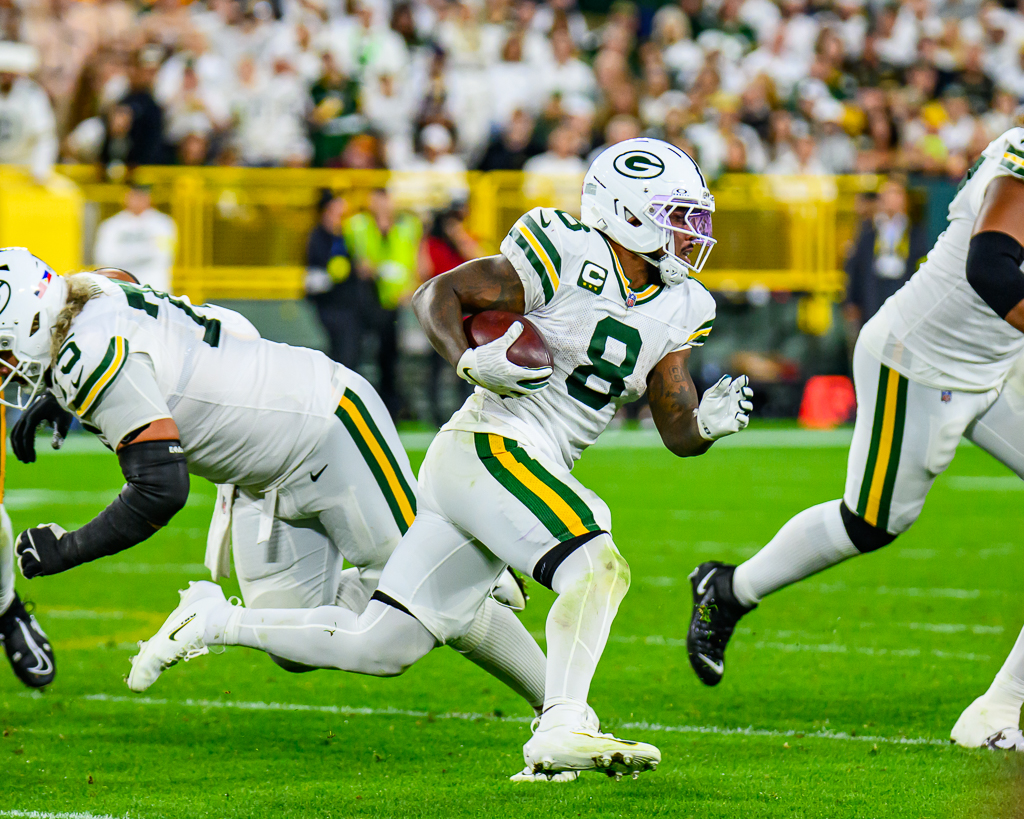
November 21: a return in a different roster category
Pierre Strong Jr. is back with Green Bay, two calendar days after the Packers released him. The club’s transaction register records a November 21 practice-squad signing, and the current roster lists him in that section. His October 8 promotion, November 19 release and Saturday return are three separate roster decisions; the latest one does not put him back on the 53-man roster.
 FULLY GUARANTEED
Green Bay still lists Josh Jacobs, Chris Brooks, Kaleb Johnson and MarShawn Lloyd as its four active-roster running backs. Keeping Strong on the practice squad gives the club another familiar option without using an active-roster place on him. A later elevation or active-roster signing would be a separate step; Saturday’s entry does not announce a game-day role or carries.
The same November 21 register entry records the release of edge defender D.J. Johnson. That is a second move involving a different position, not evidence that the two players were competing for the same playing job or an explanation of the club’s private reasoning.
Our view: Strong’s opportunity in Green Bay has reopened, but on a different contractual and roster footing. The release-to-return interval measures calendar dates, not unpaid days. The entry supplies no individual practice-squad salary, new guarantee, termination payment or exit cost for either player. His five-game work and the earlier six-week active-roster interval remain dated context below.
November 19–20: the release and active-roster snapshot before his return
Green Bay released running back Pierre Strong Jr. on November 19, according to the Packers’ transaction register. His active-roster stint began with an October 8 promotion from the practice squad. Those entries are 42 calendar days apart—six weeks between getting the roster place and losing it. The interval measures the dates, not a verified number of paid weeks.
The club’s November 19 announcement fills in the work behind that roster stint: five games, 25 carries for 59 yards and 10 receptions for 61 yards. Those totals describe Strong’s use in Green Bay. The six-week calendar interval does not mean six appearances, and the rushing and receiving yards are separate measures. Neither the workload nor the release announcement establishes an individual salary loss or a future offer.
The Packers’ active-roster snapshot as of November 20 lists Josh Jacobs, Chris Brooks, Kaleb Johnson and MarShawn Lloyd at running back. Green Bay activated Brooks from injured reserve November 14, in the same notice that returned receiver Skyy Moore. Strong’s release follows that move. The sequence identifies the options Green Bay has brought back and kept; the register does not say Brooks’s return caused Strong’s departure or allocate the next game’s carries.
FULLY GUARANTEED with J. LalwaniSix weeks between two roster decisions.
Pierre Strong’s documented route from the practice squad to the 53 and out of Green Bay.
Promoted
Practice squad to active roster.
Released
The Packers’ register records the departure.
42 days
Calendar interval, not a verified paid-week count.
The next roster and contract decision
A place on the 53-man roster and a practice-squad job offer different routes to the field. Strong had moved from one to the other in October. Keeping him would have preserved another running-back option at the cost of a roster place. Green Bay’s listed backfield has four active players in that snapshot, with their actual assignments still to be established by the lineup and game.
His next opportunity also has a contract mechanism behind it. NFL Football Operations explains that after the trade deadline, released contracts are subject to waivers regardless of credited seasons; another club can claim a contract before the player becomes a free agent. The Packers’ entry announces Strong’s departure, with no new team or subsequent agreement identified in that notice.
The announcement supplies no individual termination payment, remaining guarantee, cash savings or new contract value. A released roster place does not by itself establish how much money the player loses or the club saves. For Strong, the immediate change is the end of an active-roster opportunity that had opened six weeks earlier. For Green Bay, the next backfield choices start with the four players in that active-roster snapshot.
Financial & reporting sources
- Green Bay Packers — November 21 practice-squad signing and paired D.J. Johnson release
- Green Bay Packers — November 19 release announcement and five-game usage totals
- Green Bay Packers — November 19 release, October 8 promotion and November 14 activations
- Green Bay Packers — current active roster
- NFL Football Operations — roster and waiver mechanisms
- NFL — November 19 league roundup