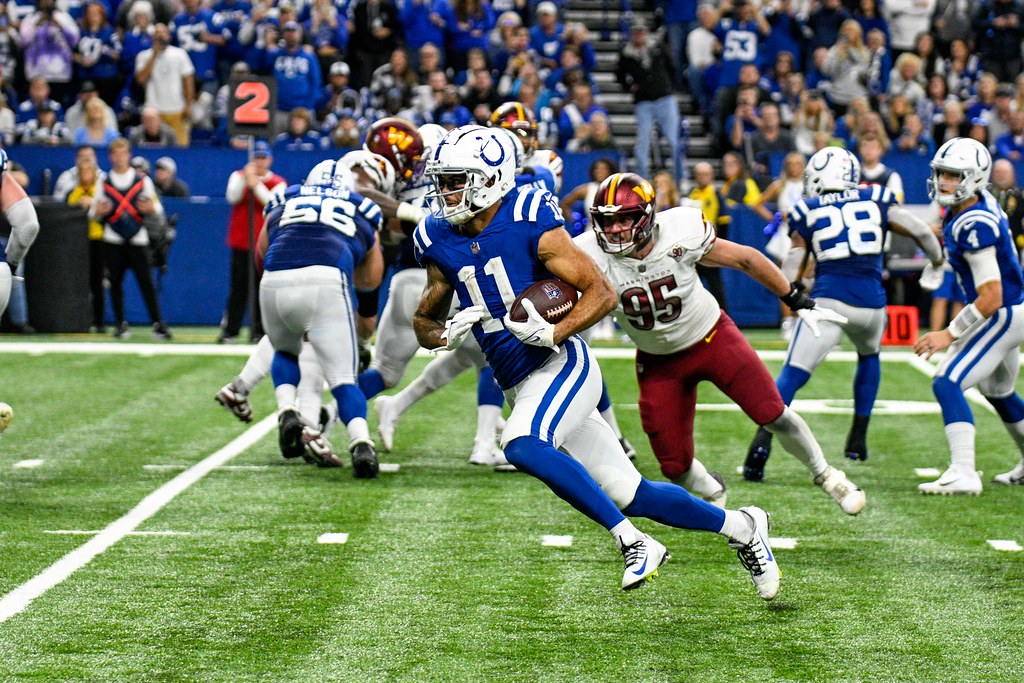
Quenton Nelson had a minor knee procedure Monday and will miss Sunday’s game at Las Vegas, Seattle coach Mike Macdonald said. That will be two straight games out after one start for the Seahawks. Macdonald still calls him week to week, and the club is keeping him off injured reserve for now. Seattle sent two future picks to Indianapolis for help in the final year of Nelson’s contract. Its first look at him lasted one game, and every week he misses shortens the time Seattle gets to evaluate that investment.
Seattle’s replacements are already on the field
Macdonald said Friday that Nelson was already dealing with the knee issue before the October 27 trade and that it had worsened since he arrived. The club re-imaged the knee and decided to address it. Nelson had started seven games for the Colts and one for Seattle, against Chicago, before sitting out against Arizona. Macdonald’s account leaves the specific play, the results of the trade physical and any effect on the deal’s terms open.
The November 6 injury report recorded limited participation Wednesday, when Seattle estimated it from a walkthrough, then no participation Thursday or Friday. NFL Network’s Ian Rapoport reported that the procedure would clean out cartilage and estimated a few weeks out. The club has since confirmed that the procedure took place, with the Raiders game ruled out and a bye to follow. Seattle’s update gives no firm return date.
Seattle already had to put its alternative on the field. Grey Zabel returned to left guard, where the club says he had played before Nelson arrived, and Anthony Bradford started at right guard in the 17–3 win over Arizona. The official gamebook records both starts. That is the lineup Seattle can use while Nelson recovers. It tells the coaches what they can do this week, and leaves them with less evidence of what their new guard could do over a full stretch of games.
 FULLY GUARANTEED
with J. Lalwani
Over The Cap still lists Seattle’s 2026 cash and cap charge at $9,777,778 each and Nelson as an unrestricted free agent in 2027. Its November 11 projected 2027 offensive-line franchise tender is $30.076 million. That is $10.076 million above the old extension’s $20 million annual average. A possible one-year tender and a multiyear average measure different things. The club’s immediate question is how much playing time it can get from the contract it acquired. A new agreement would be another negotiation.
November 3: What the debut established
Nelson’s Seattle debut is now part of the record. Andrew Destin’s November 3 account for The Athletic, republished by NFL.com, describes the recently acquired left guard making his first Seahawks appearance in Monday’s 34–17 loss to Chicago. The trade has moved from a planned assignment to actual playing evidence.
Seattle’s own pregame announcement on November 2 listed Nelson as active, with him at left guard and Grey Zabel moving to right guard. That confirms the club’s stated lineup plan. Destin’s later game account establishes the debut; neither account supplies an individual blocking grade that can settle the trade’s value.
Our analysis: one team result does not finish the evaluation of one lineman. Seattle has begun using the player it acquired, while the picks surrendered, acquired compensation and possible next agreement remain separate questions. The October 30 account below preserves those distinctions. Its contract and projected-tender figures still match the November 3 database checks; no new extension or personal franchise tender is established.
October 30: What Seattle paid and what comes next
Seattle’s October 27 announcement identified a third-round pick in 2027 and a fifth-round pick in 2028 going to Indianapolis for Quenton Nelson, initially subject to a physical. The clubs announced matching compensation. Seattle’s October 29 coverage now places Nelson in practice and at left guard, with Grey Zabel moving right and Anthony Bradford moving to a reserve role. That later account does not publish a medical examination result.
That is a consequential purchase of present-tense help with future-tense assets. Indianapolis gets two identified selections instead of carrying the same veteran decision toward the end of the season. The draft picks are the acquisition price; the employment contract governs a different part of the bill.
Nelson described the move as “a little bittersweet” in John Boyle’s October 29 club report. He spoke about relationships formed in Indianapolis and learning Seattle’s terminology. Publicly expressed appreciation and a new assignment provide human context; they do not disclose an extension price or a private negotiating promise.
The direction matters: the third and fifth go from Seattle to Indianapolis. Neither team announcement identifies a performance condition that would change those rounds. A future pick’s eventual position within its round remains unknown.
For the buyer, the argument is immediate usefulness. A draft selection is an opportunity to find a player later; Nelson is a player Seattle can evaluate for a current role now. That does not make the opportunity cost disappear. Seattle has surrendered two chances to acquire inexpensive young talent, and any assessment of the deal has to include what it can reasonably obtain from Nelson during the contract it is acquiring.
The seller’s alternative was to keep him. Indianapolis’ own announcement says rookie Jalen Farmer could get a look at left guard following the move. That is a possibility, not a promise that Farmer will match the outgoing player’s performance. Turning a veteran into selections also transfers immediate uncertainty to the remaining line.
Nelson’s 2022 extension added four years and $80 million: $20 million annually. Pro Football Talk reported a $31 million included signing bonus and $41 million fully guaranteed at signing. OTC’s notes describe $60 million in total guarantees, including $19 million of 2024 salary that vested later.
Those historical terms do not establish unpaid guarantees. The original 2026 schedule combined a $16 million base salary and $2 million roster bonus: $18 million for the full season, rather than the balance acquired in the trade.
OTC’s October 30 snapshot still lists Seattle’s 2026 cash and cap charge at $9,777,778 each, with unrestricted free agency in 2027. These are dated database figures, subject to accounting updates; they are not payroll receipts.
Seattle has negotiated the announced draft compensation with Indianapolis. Any negotiation with Nelson about staying beyond the current contract is another decision. Acquiring the player does not establish an agreed extension.
On October 30, Over The Cap projected a $30.104 million offensive-line franchise tender for 2027, or $10.104 million more than the old extension’s $20 million annual average. The database bases those projections on an estimated future salary cap. The updated November 11 figure appears above. Both are estimates for the position, and neither is an announced Seattle offer.
The executed CBA groups offensive linemen together. For a nonexclusive franchise tender, Article 10 requires the greater of its positional cap-percentage calculation or 120% of the player’s defined Prior Year Salary. That salary definition includes specified bonuses and prorated signing money; the old APY or Seattle’s remaining acquired cash cannot simply be substituted. A projected table row alone does not establish Nelson’s personal required tender.
An acquiring club can value the immediate playing window enough to make a trade without already having a long-term extension. If Seattle later seeks a new agreement, its alternatives include negotiating with Nelson, using the existing contract and revisiting the position afterward, or pursuing another personnel route. Their relative appeal will depend on performance, health, available replacements and price.
For Nelson, moving clubs changes the setting in which he will demonstrate his value. A new organization must decide how he fits its plans. That creates real professional stakes without supplying evidence about his private preference or a future asking price. No extension terms have been announced in the sources used for this article.
Indianapolis has exchanged the chance to retain his play through the remaining contract for assets it can deploy later. Seattle has accepted that later cost to improve a present roster. Neither side gets to grade the entire transaction merely by counting the number of picks.
The sensible test is whether the playing value Seattle receives justifies the picks and the acquired compensation, with any later extension judged on its own terms. Indianapolis should be judged on the value of the return and the consequences of replacing Nelson, rather than treating draft capital as an automatic win.
A veteran trade can solve an immediate roster problem and create a new contract decision at the same time. Seattle has chosen to make that decision from inside its own building. The current role is clearer; the next deal remains a separate negotiation.
Financial & reporting sources
- Seattle Seahawks — November 9 procedure, Raiders absence and week-to-week outlook
- NFL — Week 9 gamebook and actual Seattle starting lineup
- Seattle Seahawks — official Week 9 game-day inactive list
- Mike Macdonald, Seahawks — November 6 press conference and knee chronology
- John Boyle, Seahawks — original report of the coach’s knee chronology and planned procedure
- Seahawks — Quenton Nelson’s official game log, 2026 regular season
- John Boyle, Seahawks — November 6 final report and named guard replacements
- Seahawks — final practice and game designation table
- NFL.com — Friday roundup with Ian Rapoport’s attributed procedure reporting
- Seahawks — official 2026 transaction register
- Andrew Destin, The Athletic via NFL.com — Seattle debut
- Seahawks — November 2 active status and original lineup
- John Boyle, Seahawks — October 29 Nelson reaction and role
- Seahawks — original trade announcement
- Colts — original compensation and lineup outlook
- Over The Cap — original and acquired contract accounting
- Pro Football Talk — original extension terms
- Over The Cap — projected positional tenders
- NFL and NFLPA — executed agreement, Article 10