
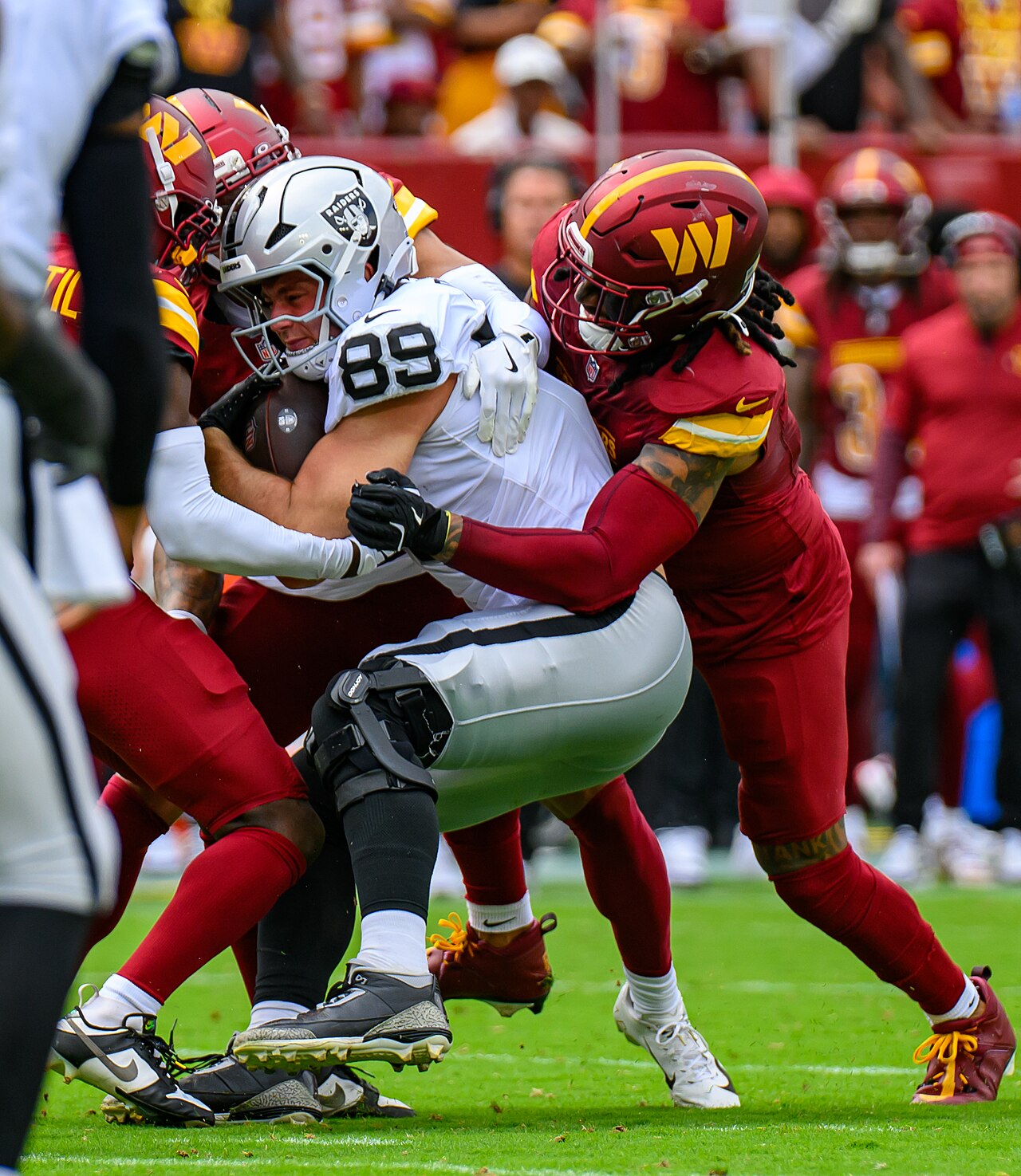

Brock Bowers’ next contract negotiation has a start line. After the Raiders’ final regular-season game of 2026, the tight end becomes eligible for an extension. Whether agreeing early makes sense depends on the price and on what each side gets in return.
Las Vegas signed its 2024 first-round pick on May 9 of that year. The CBA bars renegotiating a drafted rookie’s deal before his third regular season ends. Bowers is completing that third year.
His rookie agreement covers 2027. The Raiders also have an unexercised option for 2028, with a decision due in spring 2027. An available club choice is different from a signed extra season.
BROCK BOWERS · CONTRACT CALENDAR · NOVEMBER 26, 2026
Three years.
Three different decisions.
Extension eligibility begins after the final regular-season game.
The existing rookie contract covers this season.
Unexercised. Las Vegas has a separate decision in spring 2027.
An extension opportunity is not an announced agreement.
Sources: CBA Article 7, Sections 3 and 7 · Over The Cap.
Robert LaMar’s November 25 Dice City Sports column argues for an extension and floats a conceivable $25 million–$30 million annual average. That is the columnist’s projection, not a reported Bowers demand, Raiders offer or agreement. Over The Cap’s current tight-end table places George Kittle first at $19.1 million a year. LaMar’s range would exceed that benchmark substantially; it does not establish where a negotiation will land.
The existing contract supplies a firmer baseline. Over The Cap lists four years and $18,138,784, fully guaranteed at signing, including a $10,011,844 signing bonus. The bonus is included in the total, not additional money. That original guarantee also should not be mistaken for an unpaid balance remaining today.
The database schedules $2,443,980 in 2026 cash: $1,075,000 in base salary plus a $1,368,980 roster bonus. Its $4,946,941 cap charge adds $2,502,961 of signing-bonus proration, an accounting allocation rather than another current-year payment. Scheduled 2027 cash is $3,268,470. Those are contract-year figures, not a calculation of what remains unpaid this November.
There is a football decision alongside the contract calendar. The Raiders’ Wednesday injury report lists Bowers limited with an ankle injury and Michael Mayer participating fully with a back injury. It gives Bowers no final game designation for Sunday against Cleveland. Practice participation supplies current evidence about availability, without settling Sunday’s workload or a future contract price.
Mayer’s presence gives Las Vegas a particular alternative in its tight-end room, as the club’s recent games have demonstrated. An alternative can help cover snaps; it does not prove the team can replace everything Bowers does. For Bowers, continuing on the rookie deal leaves time to produce more evidence before making a longer commitment. For Las Vegas, waiting preserves its existing decision points while exposing it to whatever performance and the tight-end market do next. An earlier extension would let both sides negotiate how much of that uncertainty to exchange for contractual security.
Our view: start with the clocks before debating the headline price. The end of 2026 creates the first extension opportunity. The signed 2027 season provides an existing commitment. The 2028 option is another decision still to be made. If talks produce an agreement, its new money, cash schedule, guarantees and conditions will tell us far more than a projected annual average. Until then, the $25 million–$30 million range belongs in the opinion column.
Sources
- Raiders Communications — May 9, 2024 rookie signing and draft selection
- NFL–NFLPA collective bargaining agreement, Article 7 — rookie renegotiation and fifth-year option rules
- Over The Cap — Bowers original contract, guarantees, scheduled cash and cap accounting
- Over The Cap — current tight-end annual-average ranking
- Robert LaMar, Dice City Sports — November 25 opinion and projected extension range
- Las Vegas Raiders — Wednesday Week 12 practice report
- Fully Guaranteed — dated Bowers/Mayer availability and demonstrated alternatives