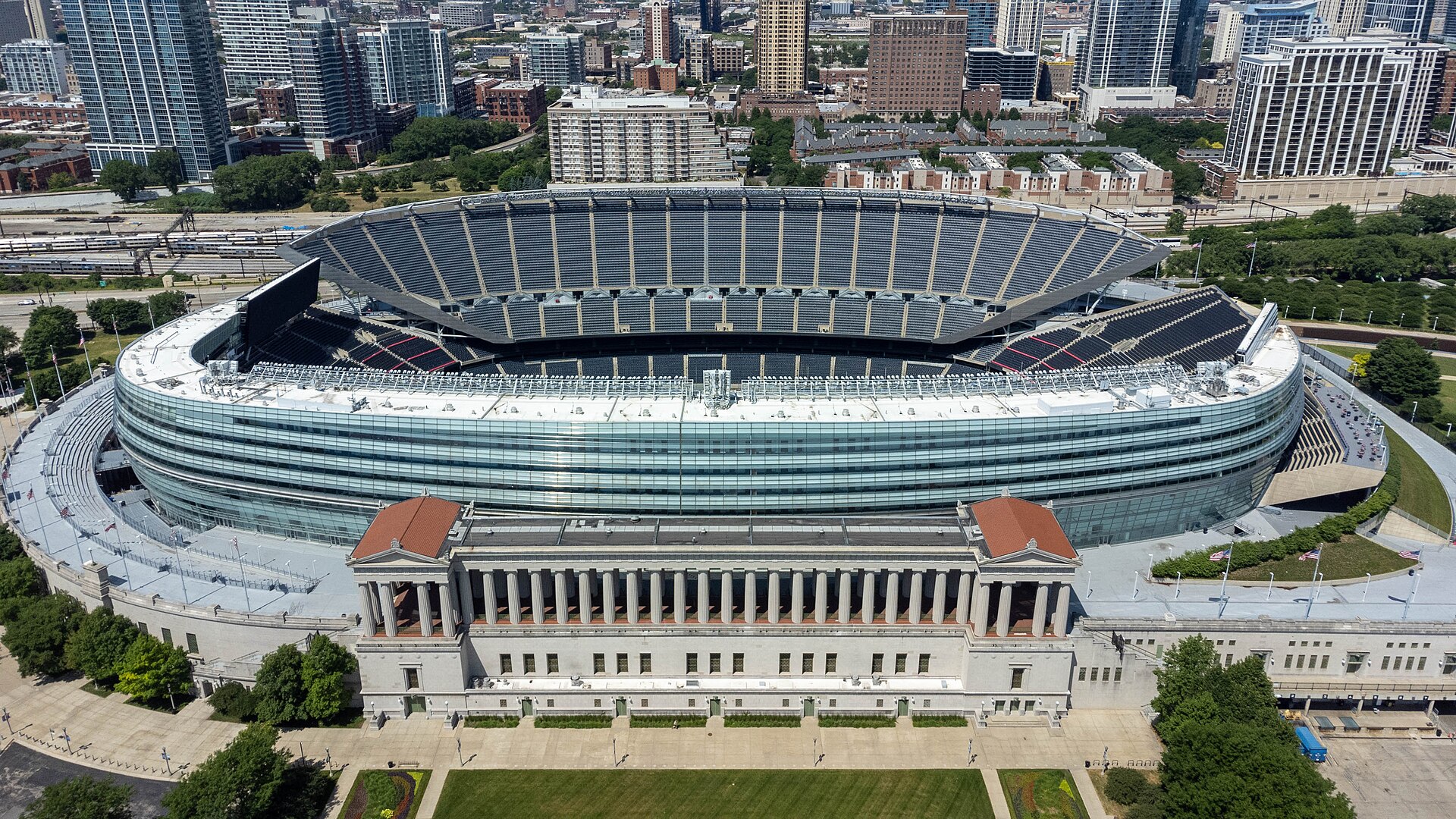

The Bears have updated the NFL on their stadium search while Illinois negotiators work toward the December 1–3 veto-session block. ABC7 Chicago’s Craig Wall reported Friday that Kevin Warren and George McCaskey briefed the league’s Stadium Committee in New York this week. State Sen. Bill Cunningham described proposed changes to the stadium-authority legislation as minor and the talks as productive. Neither description supplies the votes to pass a plan.
Cunningham’s qualification was that what legislators are prepared to support and vote for matters more than what participants agree around a negotiating table. Both official chamber calendars list December 1–3. The NFL’s calendar separately lists a December 9 virtual special league meeting. Consultant Marc Ganis told ABC7 that failure to secure Illinois approval by December 3 could lead to NFL approval to move ahead in Indiana on December 9. That is his conditional assessment, rather than an announced Bears decision or a confirmed vote on the meeting agenda.
 FULLY GUARANTEED
with J. Lalwani
How the Illinois proposal reached this point
As of November 16, the Illinois House had two floor days scheduled for the opening veto-session block. Its Nov. 14 bulletin canceled Thursday, Nov. 19. The Senate’s posted calendar still lists Nov. 17–19, and both chambers list Dec. 1–3. Gov. JB Pritzker said on Nov. 6 that he hoped lawmakers would hold hearings in November and vote in early December. The House’s first block therefore had one fewer scheduled floor day. Negotiators still had bill text and votes to settle.
On Nov. 6, the Chicago Sun-Times reported that NFL Commissioner Roger Goodell joined Bears chairman George McCaskey and team president Kevin Warren in a meeting with Illinois lawmakers. NBC Chicago’s Paris Schutz reported that a senior official from the governor’s office was there and carried the Bears’ statement that the club was still doing due diligence on two sites around Wolf Lake in Hammond. Hammond had a board decision to advance the project, with land still under evaluation.
The November 16 calendar snapshot
FULLY GUARANTEEDwith J. Lalwani
The spring bill shows why those calendar dates matter. The Senate amended House Bill 958, the House put the amendments on its concurrence calendar June 1, and the bill returned to the House Rules Committee July 1. If a new bill passes after May 31, the Illinois Constitution requires three-fifths of the elected members in each chamber to provide for an effective date earlier than June 1 of the next year. The vote count for a particular plan depends on the bill and its effective date. HB 958’s dated history does not identify a November filing for the proposal.
The Bears already own 326 acres in Arlington Heights. The club announced the purchase agreement in September 2021 and closed in February 2023. In August, the Bears described $2 billion of their own money for the stadium itself in Hammond and a separate request for infrastructure funds. For residents weighing either plan, the next document needs to identify who pays for the roads and utilities, what the public would own, and which party carries the risk if the work costs more.
October 22: What Pritzker’s earlier forecast established
Illinois Gov. JB Pritzker’s expectation of a November path to keeping the Bears in the state dates to the October 13 WTTW candidate forum. It was recapped in Mitchell Armentrout’s October 19 Chicago Sun-Times report. The later publication date should not be mistaken for a new statement.
The primary forum transcript pairs Pritzker’s forecast with a taxpayer-protection condition. The surrounding discussion also describes willingness to support infrastructure, including underground utilities, roads and bridges. That context does not support translating his position into a promise of zero public spending.
Our analysis: naming a month can focus a negotiation and invite other participants to respond. It does not, by itself, identify an agreed site, a committed public contribution or an enforceable completion deadline. The weight of a timetable depends on the actions and approvals that stand behind it.
Armentrout’s account describes no clear breakthrough and distinguishes possible legislative approaches, including a stadium-authority model and a PILOT proposal. It discusses a fall veto-session path and a later January alternative. Those are reported paths to a bargain, not proof that the bargain has been enacted.
A public-cost claim should identify which expenses are included, who pays them, when payments occur and which risks remain public. Calling an expense infrastructure does not make it disappear. Equally, a willingness to discuss infrastructure does not establish the size or conditions of an unapproved contribution.
For residents, those distinctions affect how a proposal can be judged before anyone signs it. For the club, credible location and financing alternatives matter only insofar as they can actually be executed. A political statement can signal a boundary without revealing every private reservation or acceptable concession.
Treat the governor’s forecast as a dated negotiating signal and evaluate the eventual documents on their own terms. The test for Springfield is what appears in the bill. The Bears can keep working with Indiana while Illinois lawmakers decide who can own the stadium, who pays for roads and utilities, and what happens if the bill comes due higher than anyone budgeted.
Financial & reporting sources
- Chicago Sun-Times — November 6 reporting on the Goodell meeting
- Paris Schutz, NBC Chicago — Pritzker’s November 6 comments and the Bears’ statement
- Illinois House — 2026 veto session calendar
- Illinois Senate — 2026 veto session calendar
- Illinois Constitution — Article IV, Section 10
- Illinois General Assembly — HB 958 legislative history
- Chicago Bears — Hammond construction funding and due diligence
- Chicago Bears — Arlington parcel and 2026 stadium update
- Chicago Bears and Churchill Downs — September 2021 agreement
- Chicago Bears — February 2023 Arlington closing
- WTTW/PBS — October 13 forum transcript
- Matt Masterson, WTTW — October 13 forum
- Mitchell Armentrout, Chicago Sun-Times — October 19 reporting
- Illinois House Nov. 14 bulletin and revised session dates
- Illinois Senate schedule and committee notices
- Mitchell Armentrout, Chicago Sun-Times, on the municipal authority proposal and unresolved funding
- Craig Wall, ABC7 Chicago — November 20 committee briefing and Cunningham/Ganis comments
- NFL — December 9 virtual special league meeting
- Illinois House — current schedule and linked November 14 bulletin