
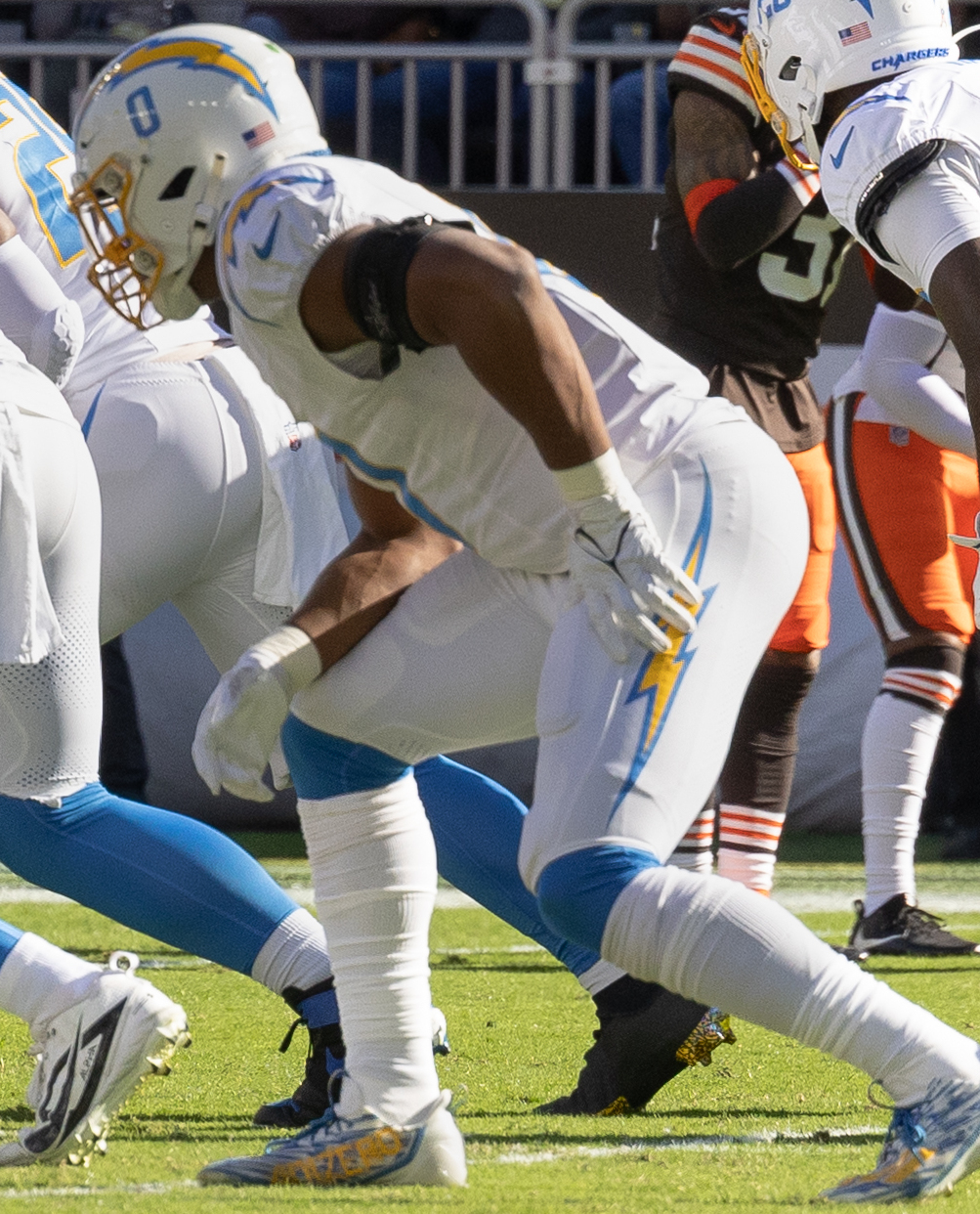

The Chargers reportedly want Daiyan Henley to stay beyond this season. Keeping him past 2026 would require another agreement, so the useful question is what turns that preference into a contract.
Albert Breer reported November 3 in Sports Illustrated that Los Angeles wanted the linebacker around long term. He also distinguished Henley from teammates who had drawn calls: Henley and Quentin Johnston were players who could attract inquiries but had not yet done so in his reporting. The report supplies a retention preference, not an extension offer, a negotiation timetable or a trade request.

Henley’s existing rookie agreement ends after 2026. Over the Cap lists him for unrestricted free agency in 2027, with a current base salary of $3,674,000 and a $3,909,532 cap charge. The $235,532 difference is signing-bonus proration. Those are current season figures, not the price of a proposed extension or a balance still owed.
The older numbers require care. His original four-year deal was worth $5,420,426, including a $942,128 signing bonus and guarantee. Its original 2026 cash schedule was $1,489,149. The current salary table is higher because the rookie framework can reward playing time without adding a contract year.
The CBA’s Level One proven-performance escalator uses a fourth-year benchmark tied to the original-round restricted-free-agent tender. For a third-round pick, one qualifying route is at least 35 percent of defensive or offensive snaps in two of his first three seasons. Over the Cap records Henley above 91 percent on defense in both 2024 and 2025. The NFL lists the 2026 benchmark at $3.674 million. That combination reconciles his listed salary with the escalator framework; it does not make him a restricted free agent now or establish a new extension.
Our read: the Chargers’ choice is whether the value they see in keeping a familiar linebacker can support terms Henley accepts. Henley’s alternative is to finish the agreement and, if his contract expires as scheduled and he is otherwise eligible, test the outside market. Waiting preserves that possibility while leaving him exposed to the ordinary uncertainty of performance and health. There is no verified competing offer to put on the other side of the table.
The Fully Guaranteed verdict: the salary increase already on the books and the next negotiation are separate stories. The first follows the rookie-contract framework. The second will need new years, compensation and risk allocation. A reported desire to keep Henley is useful context; the agreement would show what each side was prepared to give for that continuity.