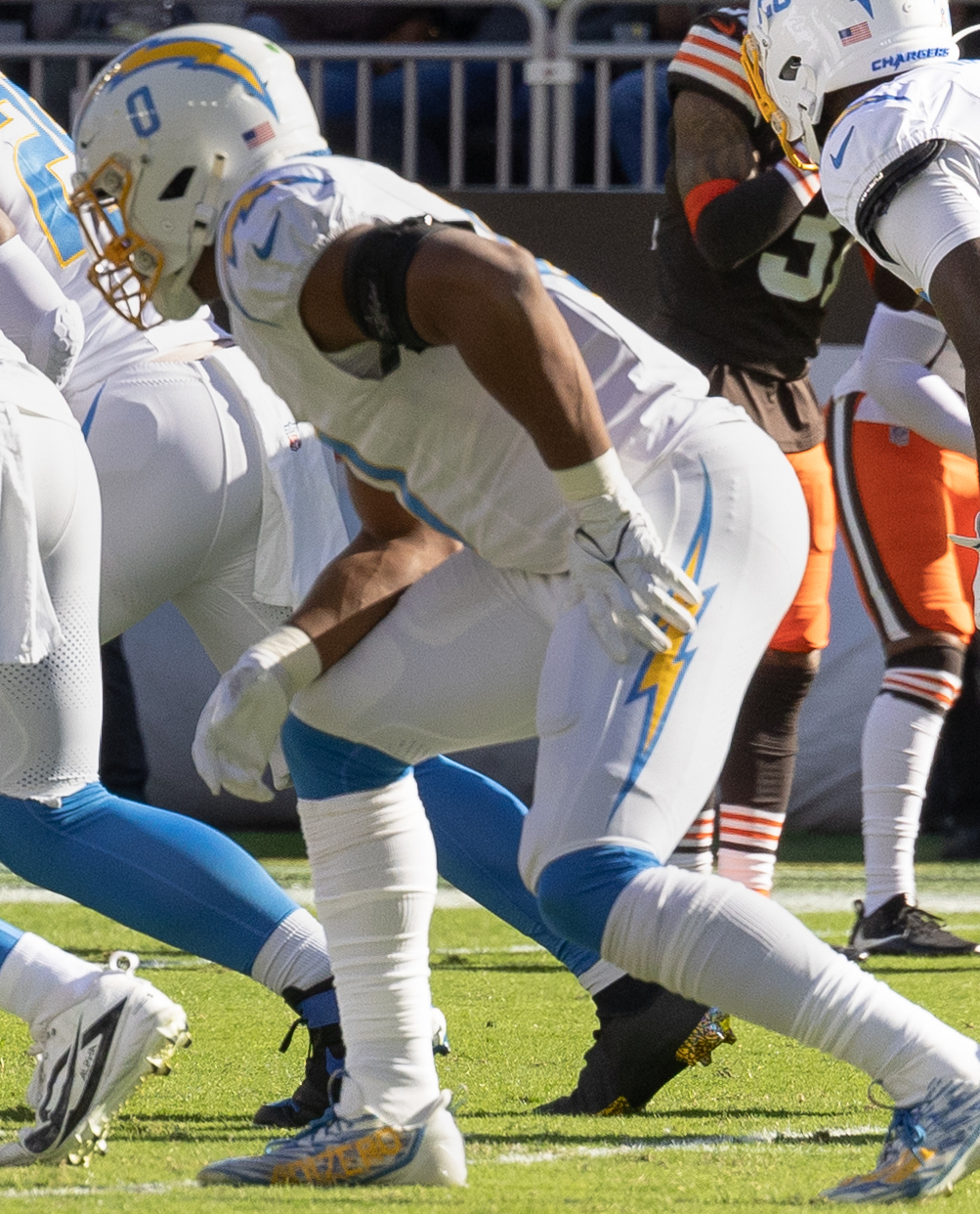

Denver and the Chargers agreed on two draft picks for Daiyan Henley. Both clubs announced an agreement on Tuesday. Denver said the trade was off Wednesday night. Chargers general manager Joe Hortiz said Denver tried to change the price after Henley’s physical. Los Angeles turned down the new terms and kept its linebacker. Denver confirmed the trade would not be finalized and gave no reason in its statement.
The NFL’s Competition Committee is expected to discuss the trade process this offseason, Adam Schefter and Ian Rapoport reported Saturday. Three deadline deals show why the discussion could get complicated. One fell apart after a physical, another went through with a reported change to a draft pick, and the third fell apart when the buyer discovered it stood to lose a pick that wasn’t in the agreement.
 FULLY GUARANTEED
with J. Lalwani
The price after the physical
The Broncos had agreed to send a 2027 fourth-rounder and a 2028 fifth-rounder to the Chargers. Neither pick moved. Hortiz said Denver still wanted Henley and floated multiple alternatives after the exam. Jim Harbaugh argued the physical should be judged on medical grounds and called for the league to look at the process. That is the Chargers’ account. Denver’s statement confirms the outcome, without detailing what its doctors found or how it weighed the exam.
A sixth-rounder, one year later
Detroit and the Jets found enough common ground to finish their trade. Both clubs initially announced that Detroit would send a 2028 sixth-rounder to New York for safety Andre Cisco. Richard Silva of The Detroit News reported that the following day’s league personnel notice moved the sixth-rounder to 2029 and left the other terms intact. The public NFL trade tracker still shows 2028. On the reported terms, the Jets kept a sixth-round selection and had to wait another draft to use it.
The pick outside the deal
Cincinnati was prepared to send Philadelphia a 2027 sixth-rounder for Arnold Ebiketie. The price on paper left out a potential cost to the Bengals. Nick Korte of Over The Cap projected that acquiring Ebiketie, who counted as a compensatory free agent, would cancel the 2027 compensatory third-rounder Cincinnati stood to receive after losing Trey Hendrickson to Baltimore. The collective bargaining agreement counts qualifying acquisitions in the compensatory formula. Cincinnati backed out, according to NFL Network and ESPN reporting. The sixth never moved. The third remains a projection.
What a fixed price would change
Schefter and Rapoport described one possible approach as freezing the draft-pick terms once clubs agree and leaving them to close the trade or walk away. A fixed price would take away the buyer’s leverage to ask for a discount after the seller’s other options have narrowed. It would also take away the option both clubs used in the Cisco deal: accepting revised terms to keep the player moving. The league’s published process requires 24 of 32 owners to support a new rule or revision. The reported discussion is still at an earlier stage.
My preference is to settle the pick math before the announcement and write the exit conditions down. Give clubs room to act on medical information, put a deadline on that decision and make any change to the price visible when the deal closes. The point for a player is practical. When both cities have been told he’s moving, he should have a clear answer about where he reports next.
Financial & reporting sources
- Adam Schefter and Ian Rapoport, ESPN, on expected committee discussion and the three transactions
- Los Angeles Chargers, Joe Hortiz and Jim Harbaugh on the Henley agreement and physical
- Denver Broncos, November 11 statement on the Henley trade
- Detroit Lions, initial Cisco agreement
- New York Jets, initial Cisco agreement
- Richard Silva, The Detroit News, on the amended NFL personnel notice
- NFL.com public trade tracker
- NFL Network, the Ebiketie agreement and initial compensatory-pick analysis
- NFL–NFLPA collective bargaining agreement, Appendix V, reproduced by Over The Cap
- NFL Football Operations, Competition Committee and general rule-change process