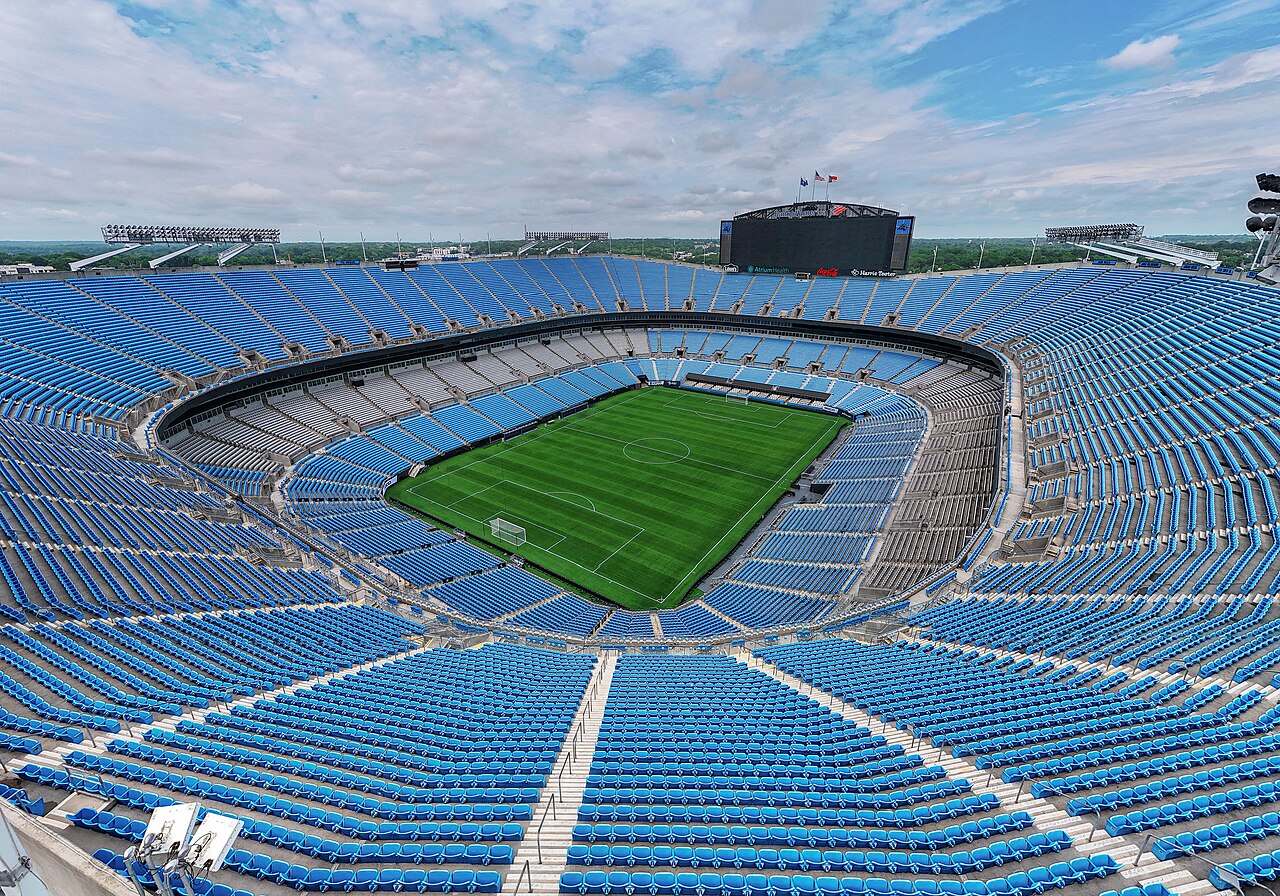

David Tepper’s account of becoming accepted in Charlotte has renewed scrutiny of the stadium subsidy. In Ben Fischer’s October 26 Sports Business Journal profile, the Panthers owner describes gaining a welcome among business leaders at Quail Hollow. Neil deMause’s Field of Schemes commentary interprets that access as part of the subsidy story. The interview establishes what Tepper said about his relationships; it does not establish a transaction between golf-club access and a council vote.
Our analysis: relationships can be relevant to how a project is promoted, but a causal claim needs evidence of the actual decision-making. The financing documents provide a firmer starting point for evaluating what Charlotte committed and what the private side promised. This is a review of those arrangements following the October profile, rather than a newly announced subsidy.
What Charlotte authorized
Charlotte’s June 24, 2024 vote authorized agreements for up to $650 million in public improvements. Approved terms paired that with at least $150 million privately: an $800 million starting package. These approvals do not establish cash disbursement.
The project subsequently grew. Fischer reports that July’s additional $500 million private investment moved the reported total to $1.3 billion. The July 23 joint announcement on the project’s official site says Charlotte’s commitment remains fixed at $650 million, with TSE funding the expanded optional work, potential overages and ongoing maintenance obligations. The release describes a project exceeding $1.3 billion; the commonly reported $1.3 billion is a rounded benchmark.
 FULLY GUARANTEED
with J. Lalwani
The percentage changes; the public dollars do not
Using the reported budget figures, our arithmetic puts the public portion at 81.25% of the original $800 million package and approximately 50% of a $1.3 billion project. A smaller percentage has not reduced the nominal $650 million commitment. These are shares of project budgets, not an estimate of final taxpayer cost, debt interest or a measured economic return.
The debt is another distinct measure. North Carolina’s treasurer reported that the Local Government Commission approved $650 million in special-obligation bonds on April 1, 2026, with debt service to come from occupancy and prepared-food tax revenues. That is financing approval. It does not, by itself, tell us how much work has been paid for, the total interest ultimately incurred or the project’s net benefit to residents.
Do not add every promise into one construction total
Those approved terms also specified at least $421 million for capital work, operations and maintenance during the non-relocation period. Spending above the $150 million minimum could count, excluding overruns. Adding $421 million to the later private expansion risks double counting. Final spending needs separate accounting.
Our analysis: Charlotte’s bargaining position should be assessed through the obligations it secured, their enforcement and the public resources committed. For TSE, broader programming and upgraded commercial spaces may create opportunities, but projected activity is not a verified fiscal return to the city. The interview and the announcements do not supply a completed, independently audited result.
Fully Guaranteed’s view: scrutinize both the public commitment and the private expansion. The changed funding proportion is meaningful, while the public dollars still require accountability. A persuasive story about belonging in Charlotte cannot substitute for that accounting, and an account of social access alone cannot prove why individual officials voted.
Financial & reporting sources
- Ben Fischer, Sports Business Journal — original October 26 Tepper interview and project profile
- Neil deMause, Field of Schemes — October 26 commentary, distinguished from proven causation
- Charlotte City Council, file 15-22932 — June 24, 2024 action and approved business terms
- TSE / Bank of America, official project site — July 23 expansion and fixed city commitment
- North Carolina Treasurer — April 1 financing approval, reported April 2, 2026